CompactFlash card (CF card)
A CompactFlash card (CF card) is a memory card format developed by SanDisk in 1994 that uses flash memory technology to store data on a very small portable device. It has no moving mechanical parts and does not need a battery to retain data. Small memory cards allow users to add data to a wide variety of computing devices. CF cards today are primarily used as removable memory for higher-end digital photo and video cameras.
The original CompactFlash card was built using NOR flash memory. NOR flash has the advantage of being able to execute programs directly from flash without having to be copied in a device's system random access memory (RAM). However, NAND is better suited for large amounts of data storage and became the default type of flash memory used in all removable memory cards, including the CompactFlash card and its primary competitor, the Secure Digital (SD) card.
Because flash is nonvolatile memory, stored data is retained when a device's power source is turned off or lost. A CF card features solid-state construction, which makes it much more rugged than most traditional storage devices. The operating shock rating (basically, the height they can be dropped from and still work) for a CF card is 2,000 gauss (G) compared to a 100 G to 200 G rating for the mechanical drive of a typical portable computing device. This translates to a drop to the floor from 10 feet versus a single foot for the mechanical disk drive.
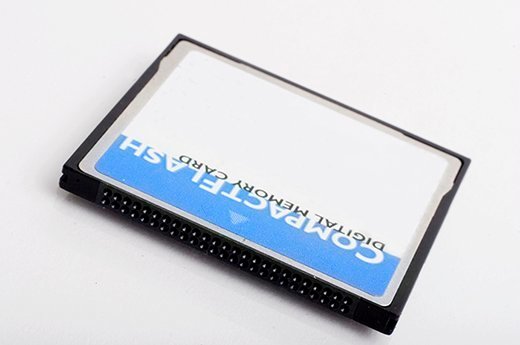
CompactFlash is a popular card choice for use with digital single-lens reflux cameras. A high-end version, Ultra CompactFlash (Ultra CF), is optimized for more demanding photography, such as a quickly shot succession of high-resolution pictures or pictures of a moving subject. Ultra CF provides a transfer rate twice that of SanDisk's standard memory cards, allowing data to be quickly saved and the camera to be ready to capture another image.
CFast, or CompactFast, combines the CompactFlash card form factor with the Serial ATA (SATA) interface.
Technical specifications and vendors
Based on the Parallel Advanced Technology Attachment (PATA) interface, CF cards measure 42.8 mm by 36.4 mm (about the size of a matchbook) and are available with storage capacities ranging up to 512 gigabytes (GB).
CompactFlash cards support 3.3V and 5V operation and can switch between the two. This varies from other small form factor flash memory, which can only operate at 1V.
There are two types of CF cards, in varying thicknesses, to accommodate different capacities: Type I CF cards are 3.3 mm thick vs. 5.0 mm for Type II cards. The extra thickness of a Type II CompactFlash card is because almost all of them were Microdrives, a tiny spinning hard disk format originally developed by IBM.
SanDisk is still one of the largest suppliers of CF cards in the world, but it has plenty of competition. Consistently getting high reviews from digital imaging websites are cards from Kingston Technology, Lexar and Transcend Information. Other suppliers include Delkin Devices, KomputerBay and Verbatim Americas.
While 512 GB CompactFlash cards are available, the best-selling size on Amazon is 32 GB, possibly because of the higher cost of CF cards compared to SD cards.
CompactFlash Association and compliance
A CompactFlash card is self-tested for interoperability by member manufacturers of the CompactFlash Association (CFA), which was established in 1995. The group cites 80 members and states it is primarily focused on the needs of the professional photo and video markets, as well as the industrial market.
Cards completing this testing are labeled as follows:
- CF 4.1a: Products are widely available at speeds up to 90 megabytes per second (MBps) sequential access speed.
- CF 5.0: Products have more efficient commands and support TRIM operations providing consistent speed.
- CF 6.0: Implements Ultra Direct Mode Access 7 (UDMA 7), which provides bus speeds up to 167 MBps, and supports the Sanitize command.
In addition to setting standards for CF and CFast cards, the CFA handles standards for the newest removable flash memory card format, XQD. Instead of connecting via the PATA bus as in a CF card or the SATA bus with a CFast card, XQD cards connect via the much faster PCI Express (PCIe) bus. A XQD card measures 29.6 mm by 38.5 mm, and is 3.8 mm thick.
Additional flash memory card formats
To save and transfer files, images and songs among devices that are ever decreasing in physical size, newer flash memory card formats were introduced. For example, Secure Digital memory cards -- which are regulated by the SD Association, an industry organization similar to the CompactFlash Association -- come in a variety of styles and capacity. SD cards are 32 mm by 24 mm by 2.1 mm in size. They are easy to spot due to their cut-corner profile.
SD cards have replaced the bulkier CompactFlash card in many device applications because of smaller size, lower weight and lower cost. Depending on the manufacturer and factors such as read/write speed, an SD card can be as much as half the cost of a CF card of equivalent data storage size.
MiniSD and microSD memory cards have been designed for use in mobile phone technology. MiniSD cards are 21.5 mm by 20 mm by 1.4 mm in size, while microSD cards are 15 mm by 11 mm by 1 mm in size.
The main difference, aside from size and cost, between SD cards and the CompactFlash card is that SD cards do not contain a microcontroller.
Other types of removable flash-based memory cards that have been developed include Sony's Memory Stick Duo, MultiMediaCard (MMC) and the xD-Picture Card. The Memory Stick is the only one of these formats still used with any regularity, but the MMC has gained a new life as a form of embedded flash memory for many device applications requiring reliability, such as in the automotive industry.
XQD cards used the first generation of the PCIe connection, capping out at a speed of 250 MBps. In April 2017, the CFA announced a new protocol, CFexpress 1.0, which is based on PCIe Gen 3 and the NVM Express (NVMe) protocols. It can operate at data speeds of up to 2 GBps and has the same form factor as XQD cards.