How many bytes for...

Data is often expressed in bytes, which are composed of eight binary digits. Bytes are used to represent all sorts of data, including letters, numbers and symbols. Each byte is made up of a string of bits that must be used in the larger unit for applications.
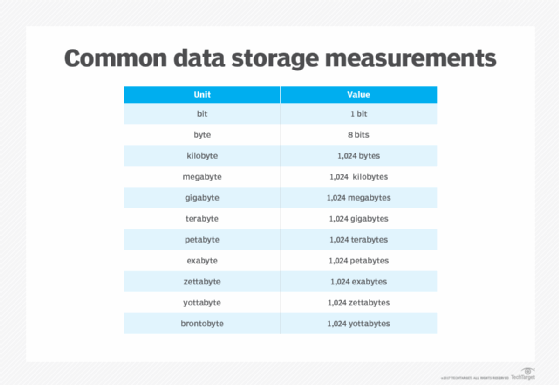
This page provides tables that include information about how many bytes are required to store data for various information objects or purposes. It also summarizes a number of facts about how much information exists in the world.
How many bytes for anything?
The following table shows information objects that range in size from 1 bit to exabytes (EB) and zettabytes (ZB).
Much of the information originally came from calculations done by Roy Williams on his "Powers of Ten," webpage, which is now expired. Data also came from the University of California at Berkeley, which derived some of its data from the Williams article. In a more recent update, data was added from Bryn Mawr College, Computer Hope, GreenNet, IDC and BBC Science.
| Information object |
How many bytes? |
| A binary decision |
1 bit |
| A single text character |
1 or 2 bytes |
| A typical text word |
10 to 20 bytes |
| A line of text |
70 bytes |
| Two or three paragraphs of text |
1 kilobyte (KB) |
| A page of plain text |
2 KB |
| A short email |
5 KB |
| A simple five-page word-processor document |
30 KB |
| A low-resolution photograph |
100 KB |
| A short novel |
1 megabyte (MB) |
| The average size of a webpage |
2 MB |
| A high-resolution photograph |
2 to 3 MB |
| A three-minute MP3 audio |
3 to 5 MB |
| The complete works of Shakespeare |
5 MB |
| One meter of shelved books |
100 MB |
| The contents of a CD-ROM |
700 MB |
| A pickup truck filled with books |
1 gigabyte (GB) |
| The contents of a single-layer DVD |
4.7 GB |
| The collected works of Beethoven |
20 GB |
| A library floor of academic journals |
100 GB |
| 50,000 trees made into paper and printed |
1 terabyte (TB) |
| An academic research library |
2 TB |
| The print collections of the U.S. Library of Congress |
15 TB |
| Total archived data for the Hubble Space Telescope |
150 TB |
| Total data the National Centers for Environmental Information managed |
30 petabytes (PB) |
| Total data Amazon, Facebook, Google and Microsoft stored |
1.2 EB |
| All words ever spoken by human beings |
5 EB |
| The installed base of storage capacity in 2020 |
6.7 ZB |
| Total data created or replicated in 2020 |
64.2 ZB |
How many bytes for a website?
The following table contains information from the Page Weight report published by HTTP Archive, an Open Source project.
| Information object |
How many bytes? |
| The average transfer size of all HTML documents requested by a webpage |
29.7 KB |
| The average transfer size of all external stylesheets requested by a webpage |
74.2 KB |
| The average transfer size of all fonts requested by a webpage |
141.1 KB |
| The average transfer size of all external scripts requested by a webpage |
505.6 KB |
| The average transfer size of all external images requested by a webpage |
979.5 KB |
| The average transfer size of all resources requested by a webpage |
2.2 MB |
| The average transfer size of all videos requested by a webpage |
2.5 MB |
| A downloadable file, program or driver |
File sizes vary; users are sometimes notified of a file's size before downloading it. |
How much information exists?
The following table includes information published by FinancesOnline, a software discovery and research platform. FinancesOnline gathered the information from a wide range of other sources.
| Information object |
How many bytes? |
| Total data created every second per person in 2016 |
1.7 MB |
| Total data a connected car produced in one day in 2020 |
4 TB |
| Total data Facebook created in one day in 2020 |
4 PB |
| Total data generated from wearable devices in 2020 |
28 PB |
| Total data created every day in 2020 |
2.5 EB |
| Total global IP data generated each month in 2021 |
278 EB |
| Total global data predicted by the end of 2021 |
74 ZB |
| Total data consumption projected from 2021 to 2024 |
149 ZB |
Learn what you need to know about how to manage data in the zettabyte era.