network operations center (NOC)

What is a network operations center (NOC)?
A network operations center (NOC) is a centralized place from which enterprise information technology (IT) administrators -- either internal or third party -- supervise, monitor and maintain a telecommunications network.
Large enterprises with extensive networks and commercial network service providers typically have a NOC (pronounced "knock"). It is usually a room equipped with devices that provide visualizations of the network or networks being monitored -- workstations at which the detailed status of the network can be seen and software for network management.
For such organizations, the NOC acts as the nervous system to manage and optimize business-critical tasks, like network troubleshooting, software distribution and updating, router and domain name management, performance monitoring and coordination with affiliated networks.
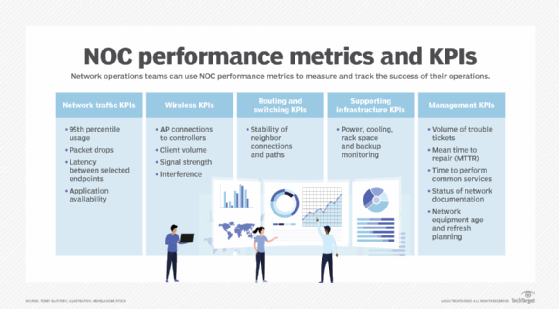
Network operations centers explained
The NOC's most important role is to provide full visibility into the enterprise infrastructure and all its components and equipment, including the following:
- firewalls
- network devices
- servers
- wireless systems
- internet of things devices
- virtual machines (VMs)
- databases
- software and services (internal and external)
In addition, NOC personnel monitor and oversee network activity reports and dashboards. They may also attend to customer help desk systems -- ticketing-based, voice-based, etc. The NOC may integrate with customers' network tools to address gaps in customer service and support. Consequently, the NOC plays an important part in improving the company's customer focus and, ultimately, in improving customer experiences.
From a security perspective, the NOC functions as the first line of defense that enables the organization to monitor network security and recognize and address any attacks or disruptions to the network.
The NOC plays a critical role in maintaining uninterrupted network availability and thus the organization's operational and business continuity.
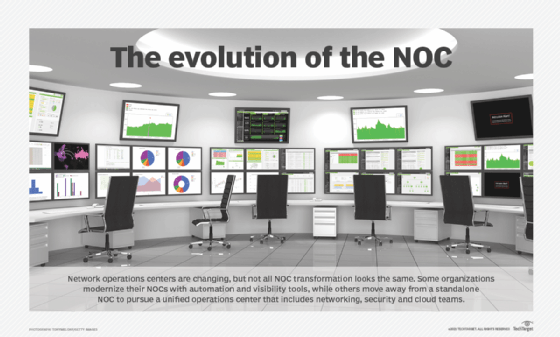
What happens within the NOC?
Often, organizations build their NOC on premises within their data centers. Some -- especially those with smaller IT teams, a relatively simple network environment or repetitive IT configurations/tasks --- may outsource NOC functionality to a third party. Third-party NOCs are external companies, often a managed service provider, that provide specialized services, typically as a cloud service, related to IT infrastructure and network monitoring, supervision and management.
Whether an internal function or outsourced to an external service, NOC staff carry out some or all of the following activities:
- network monitoring and updates
- communications management
- firewall management
- performance and quality reporting
- software installations, patching and troubleshooting
- quality control and assurance
- policy enforcement
- infrastructure and procedural changes
- threat analysis
- intrusion prevention systems
- incident response
- data storage and backup
- email management
NOC personnel are also responsible for taking action to resolve issues, anomalies or threats before they can affect business operations or lead to other problems related to service delivery or regulatory compliance.
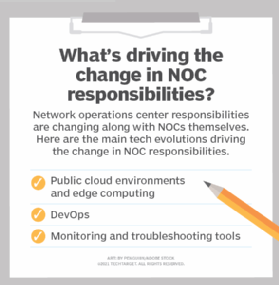
NOC vs. data center and NOC vs. SOC
Although often assumed to be the same thing, a NOC and a data center are two different things. One of the goals of the NOC is to maintain data center availability. Its size -- room and staffing level -- usually depends on the data center's size and business criticality.
Large data centers have a NOC room that functions 24/7 year-round. However, since setting up a NOC comes with considerable cost, smaller data centers typically use automated monitoring software instead. This enables them to keep an eye on their network with minimal human intervention and the costs associated with a full-time NOC staff.
A data center is a centralized location that hosts and manages the organization's computer and server equipment, databases, VMs, and security and network controls. Essentially, it provides a place for data to be collected, stored, protected and distributed in order to support enterprise operations and maintain operational continuity.
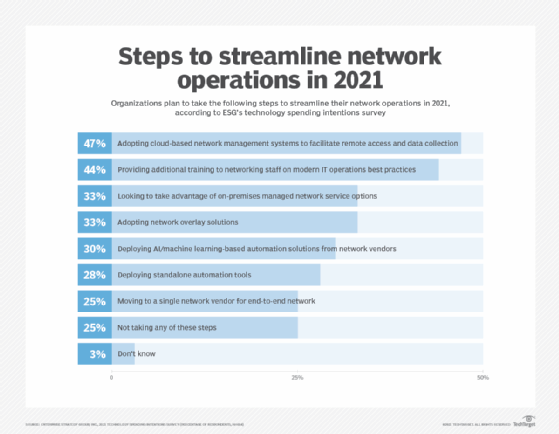
The NOC is the network-centric control room for the data center. It enables specialized personnel to monitor the data center's network infrastructure and quickly address any issues that may arise to prevent data loss. For larger organizations, the NOC and data center go hand in hand -- one is not possible without the other.
Since the NOC's role is to simply monitor the network, it does not interfere with it. A data center plays a more active role in the network, since its primary role is to continuously share data across the network and ensure its availability.
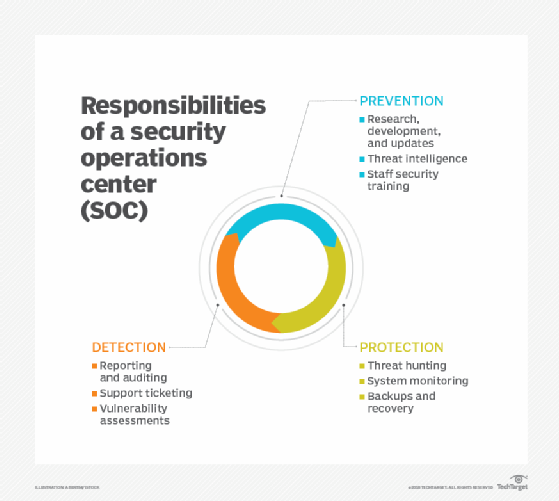
The NOC may also be confused with a security operations center (SOC). Though both work to resolve IT-related issues, the NOC focuses on monitoring and maintaining the network environment and any extensions to that infrastructure, i.e., remote connections. The SOC's focus is security, so its staff's primary function is to monitor the network for vulnerabilities, attack vectors and threats. It's also in charge of detecting anomalies and mitigating security incidents before or as they arise.
What are NOC benefits?
Companies with a dedicated NOC -- in-house/on premises or external -- can expect to realize these benefits:
- installing, troubleshooting and patching business-critical network software;
- antivirus support to prevent viruses from entering and spreading across the network in conjunction with the organization's security team;
- reporting on network health to help with optimization and problem resolution;
- monitoring and managing firewalls to ensure ongoing network and business security; and
- spotting security issues, like threats and attacks, to mitigate them and minimize damage.
Continue Reading About network operations center (NOC)
Dig Deeper on Network management and monitoring
-
![]()
Benefits and challenges of NetOps-SecOps collaboration
By: John Burke
-
![]()
5 tips for building a cybersecurity culture at your company
By: Jerald Murphy
-
![]()
Cato claims first for AI-driven networking, security incident detection and response
By: Joe O’Halloran
-
![]()
security operations center (SOC)
By: Paul Kirvan